 Skip to content

Leaf springs are the most reliable component on your entire truck or trailer. And they are the only component that will break without any warning, at 70mph, with a 3 ton trailer behind you.
Almost nobody checks them properly. Almost nobody knows what they are actually looking for.
Quick Answer
If you only have 30 seconds, these are the four signs that your leaf springs are dead:
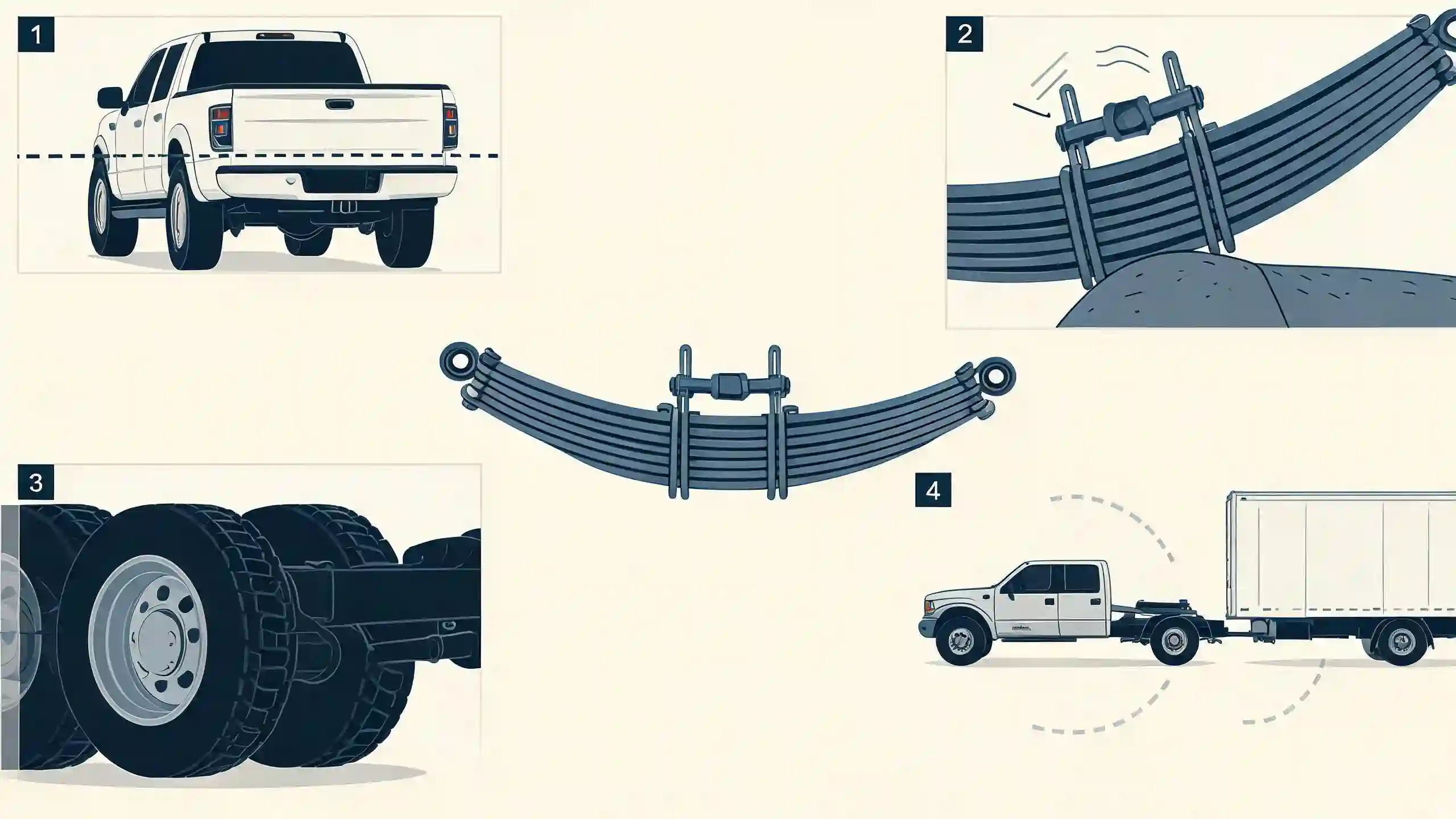
* One side of the truck sits noticeably lower than the other
* You hear a faint metallic clunk every time you go over a bump
* You can see a visible crack or broken leaf
* Your trailer starts swaying at speeds it never used to
If you have any one of these, your springs are bad. Stop guessing.
Why this matters
Leaf springs live their entire life being compressed and flexed thousands of times a day. Every pothole, every load, every tow adds a tiny little bit of metal fatigue that never goes away.
They do not fail all at once. They fail slowly, over years. And by the time you notice there is a problem, you are usually 100 miles from home, on the side of the motorway.
You should check your leaf springs at least once a year. If you tow regularly, check them every 6 months.
Signs of Bad Leaf Springs
1.Sagging arch
This is by far the most common failure mode, and 9 out of 10 drivers will never notice it. Leaf springs almost never snap with a big obvious crack. They just slowly get flatter and flatter over time.
You do not need any tools to check this. Just walk 3 meters back from the truck and stare at it. If it looks even a little bit lower on one side, it is. Your eyes are more accurate than any tape measure.
2.Faint clunking noise
The first sign of a worn spring is almost never a big loud bang. It is a very quiet, almost impossible to place metallic clunk that you only hear over small bumps. Almost everyone will blame this on the shocks, or the bushes, for at least 6 months before they check the springs.
3.Uneven tyre wear
A tired leaf spring will change your axle alignment by less than one degree, enough to destroy a set of tyres in 5000 miles, but not enough that you will notice anything wrong with the handling.
4.Sudden sway while towing
If your trailer used to be perfectly stable at 60mph, and now it starts to sway at 55, the first and only thing you should check is your leaf springs. 90% of unexplained sway is not caused by tyres or alignment. It is caused by tired springs.
Step by Step Inspection
Visual Check
Park on perfectly flat ground. Look along the side of each spring. Look for cracks, almost all of which will form within 5cm of the centre bolt. Check for rust that is flaking off in thick chunks, surface rust is normal and harmless.
The arch
A healthy leaf spring should have a clear upward curve. If it is flat, or even slightly curved downwards, it is completely worn out and should be replaced immediately.
Leaf Spring Bushings
Check the rubber bushes at each end of the main leaf.If you can see daylight through the bush, or you can move the end of the spring side to side by hand, they need replacing.
U-Bolts
Grab each U-bolt and try to wiggle it. They should not move even 1mm. Any movement at all means they are loose, and your entire spring pack can shift at any time.
Center bolt
Look along the edge of all the leaves. If any single leaf is sticking out even 1mm to the side, the centre bolt is broken. This is a ticking time bomb.
Final rules
If you have one broken leaf, replace the entire pack. Never try to just add one new leaf to an old tired pack.
Never ever replace only one leaf spring.Always replace them as a pair. Even if the other side looks perfect. If one has fatigued, the other one is two weeks behind it. Every single person that tells you otherwise is trying to sell you one spring instead of two.
Summary
Leaf springs are very simple. There are no fancy electronics, no sensors, no secret tricks. They either work, or they don’t.
A 20 minute inspection once every six months will save you from being stuck on the side of the motorway at 2am. It really is that simple.
At Everlasting we manufacture replacement leaf springs for almost every truck and trailer on the road. If you have any procurement requirements, or you just want independent advice on what rating will work best for your use case, feel free to contact our team at any time.