 Skip to content

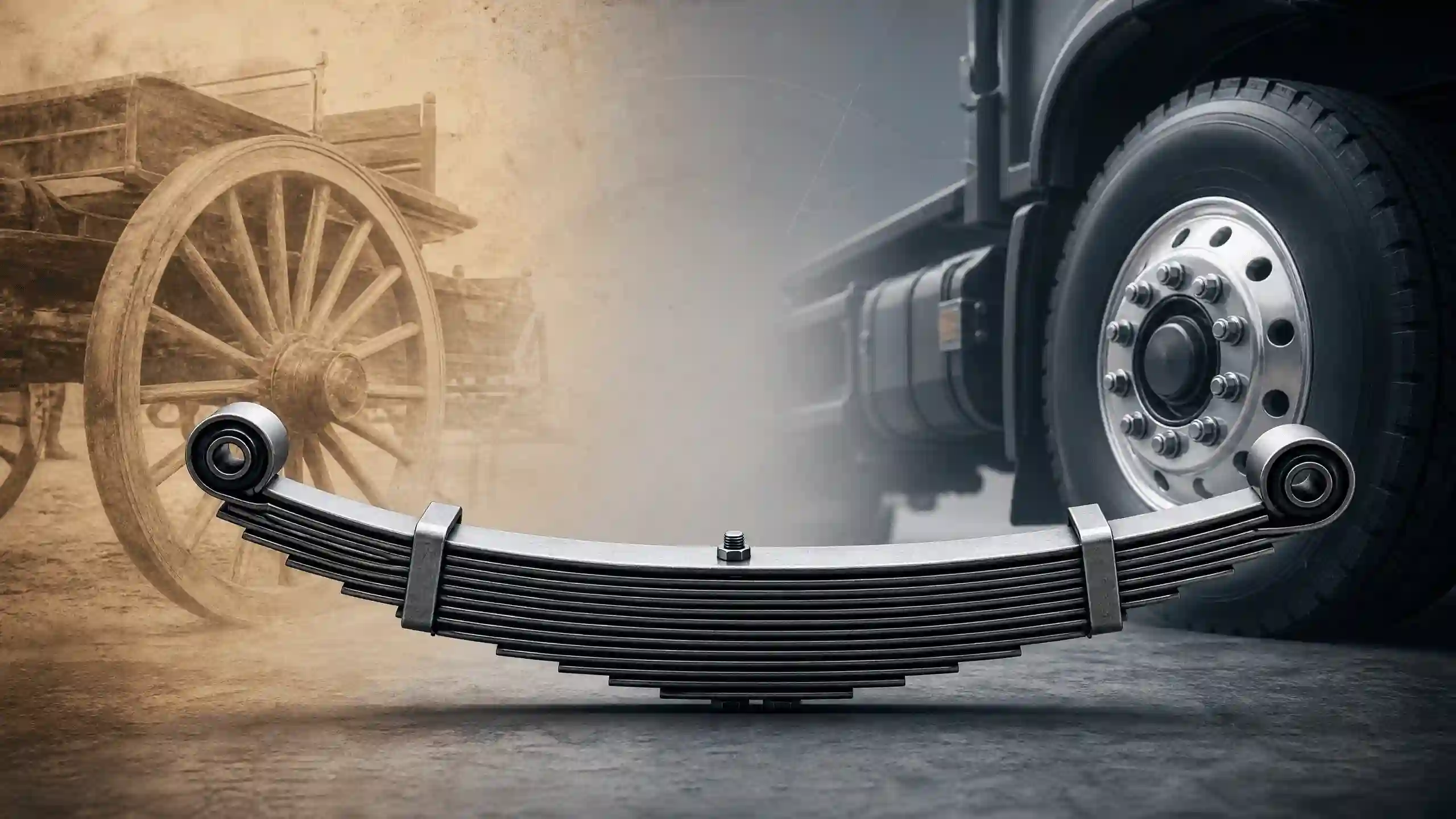
When were leaf springs invented?
In the 18th century, when horse-drawn carriages still dominated roads, people began using multi-layered steel plate structures to absorb road bumps—a precursor to the leaf spring.
The leaf spring we’re familiar with didn’t emerge suddenly; it gradually matured through continuous improvements.
The Age of Carriages
In 18th-century Europe, stone-paved roads, muddy surfaces, and vehicle tracks were ubiquitous.
The earliest suspension systems relied on simple belts or chains, offering extremely poor comfort.
Around 1760, it was discovered that stacking several curved steel plates could effectively reduce road bumps; consequently, craftsmen began replacing the wooden boards between the axle and carriage with wrought iron.
Of course, this isn’t the conventional leaf spring steel we’re familiar with, but the innovative design of stacking multiple curved iron plates together laid the foundation for modern leaf springs.
Subsequently, Obadiah Elliot applied for and obtained the patent for the oval spring in 1804, and this design gradually became the standard configuration.
The Age of Cars
By the end of the 19th century, automobiles began to appear.
The internal combustion engine replaced horses, and through the promotion by Henry Ford’s manufacturers, the familiar leaf spring gradually faded into history—early automobiles almost universally employed the leaf spring suspension system.
The reason is simple: the leaf spring features a mature design, low manufacturing cost, and high load-bearing capacity. Given the technological constraints of that era, no simpler or more reliable alternative existed.
With the advent of trucks and trailers, the importance of leaf springs has further increased.
Long-distance heavy-duty transportation requires a stable and reliable support system, and heavy-duty leaf springs perfectly meet this requirement.
Why hasn’t it been eliminated?
By the late 20th century, other types of springs had become widespread, and many passenger vehicle manufacturers began adopting more comfortable suspension systems.
While coil springs offer greater comfort, leaf springs have a higher load-bearing capacity.
When the vehicle’s primary function is long-distance transportation, a leaf spring proves significantly more practical.
This is precisely why this structure can still be found in the chassis of commercial vehicles today.
Modern Improvement
While the fundamental principles remain unchanged, technology continues to advance significantly: we now employ parabolic leaf springs, mono leaf springs, higher-strength leaf spring steel, and corrosion-resistant coatings.
These improvements make the leaf springs lighter, stronger, and more durable.
As we entered the 21st century, leaf springs have undergone significant advancements in both materials and manufacturing techniques.
The material has been upgraded from 60Si2Mn to 50CrVA; the use of this high-strength alloy has increased the leaf spring’s fatigue resistance by several times.
Process innovations continue to advance: Shot peening creates a compressive stress layer on blade surfaces, while E-coating addresses corrosion challenges under heavy-load conditions. These advancements have significantly extended the service life of modern replacement leaf springs.
Customization Support: For extreme operating conditions such as mining environments and specialized vehicles, custom leaf springs have gained popularity. Our engineers can tailor the curvature, width, and material composition to meet specific load requirements and suit actual operational environments.
It should be noted that the leaf spring does not have a precisely defined “date of invention”; it was gradually refined by humans starting in the 18th century to mitigate road bumps during vehicle travel.
From the era of horse-drawn carriages through the advent of automobiles, to today’s commercial trucks and trailers, leaf springs have undergone centuries of evolution.
Technology continues to advance, yet this simple and reliable structure remains effective.
Throughout human industrial history, some designs become obsolete while others remain irreplaceable—leaf springs belong to the latter category.
As a professional leaf spring manufacturer in the China region, if you require a safe and reliable suspension system—whether sourced from original equipment or custom parts—from SINOTRUCK to BENZ, please feel free to contact us at any time.