 Skip to content

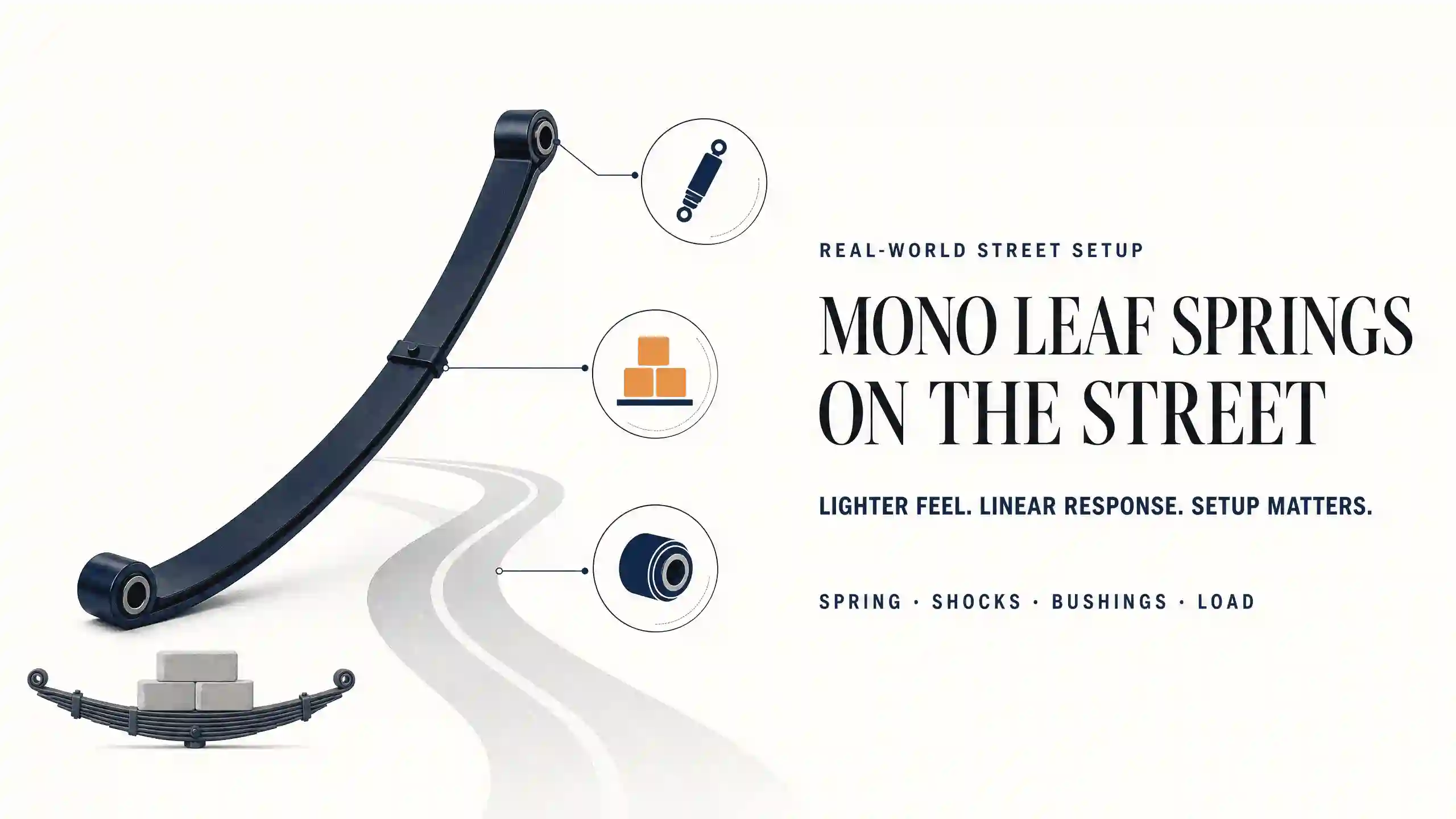
Your on-road experience isn’t just about the spring design. The vehicle itself, your shock absorbers, and how much weight you typically carry all play a role.
Quick Answer
– For daily street commuting, a mono leaf spring gives you a lighter, more responsive suspension feel—but that doesn’t always mean a more comfortable ride.
– If you haul loads regularly, a multi-leaf setup is generally the more stable and durable choice.
– Overall, mono leaf springs can be great on the street, but only when the spring and vehicle are properly matched.
What Sets Mono Leaf Springs Apart
Traditional leaf spring suspension systems use multiple leaves stacked together. The number of leaves, their thickness, and their curvature all work together to balance load capacity and flexibility.
A mono leaf spring is exactly what it sounds like—a single leaf. Fewer parts, less weight, but the trade-off is that the material and manufacturing process need to be significantly better to achieve the same strength.
The Upside of Running Mono Leaf Springs
- Lighter weight, quicker response. With a mono leafdesign, the rear end of the vehicle tends to feel more nimble. You’ll notice it most on small bumps and quick transitions—the suspension reacts faster because there’s less mass to move.
- Simpler design, less maintenance. Multi-leaf springs have multiple friction surfaces where the leaves contact each other. That’s where squeaks and inter-leaf noise tend to develop. A mono leaf has no inter-leaf contact, so in theory it’s quieter and less prone to those issues.
- Linear, predictable support. If your vehicle is set up more for street use, the consistent flex of a single leaf can deliver a more uniform, predictable feel through corners and over road undulations.
The Potential Downsides
- Stiffer when unloaded. To match the load capacity of a multi-leaf pack with a single leaf, manufacturers typically use a higher spring rate. That means when the vehicle is empty, the ride can feel noticeably harsh.
- Less haul capacity. Multi-leaf designs handle progressive loading more naturally—as you add weight, more leaves engage. A mono leaf can’t do that as easily, and building one to match multi-leaf capacity raises both cost and engineering complexity.
- Less forgiving of worn components. A mono leaf spring is more sensitive to the condition of surrounding parts. Worn bushings will amplify vibrations and noise. Incorrect shackle angle or improper U-bolt torque can throw off axle alignment more noticeably than with a multi-leaf setup.
Real-World Scenarios
You’ll see mixed reviews online—some people love their mono leaf springs, others say the ride is too harsh. More often than not, the issue isn’t the spring itself but a mismatch between the spring and the rest of the setup.
Parabolic leaf springs tend to find a better middle ground between comfort and load capacity, and generally feel more composed on the street. Coil springs are typically the most comfortable option with the most travel, but they require a more complex suspension structure.
If you mostly drive on paved roads, carry light loads, want to reduce weight, and prefer a more linear rear-end feel, a mono leaf spring is worth considering. But if you’re regularly hauling heavy loads, towing, or running work routes, stick with multi-leaf.
Tips
– Check bushings and shackles first. If they’re worn, swapping springs won’t fix your squeaks or handling issues. Take care of the bushings and shackles at the same time.
– Match your shocks. A lot of complaints about a “harsh ride” are actually shock absorber problems, not spring problems. Make sure your shocks are suited to the new spring rate.
– Torque U-bolts to spec and recheck. Leaf spring U-bolts can settle after a few hundred kilometers. Go back and retorque them—it helps prevent axle shift and keeps the handling tight.
FAQ
Q: Are mono leaf springs always more comfortable?
A: No.Many mono leaf springs run a higher rate for strength, which can actually make the ride firmer.
Q: Are they good for towing?
A: Light towing is usually fine. But if you’re doing frequent heavy towing, multi-leaf heavy-duty leaf springs are the better call.
Q: What else should I replace when switching to mono leaf?
A: Common items include bushings and U-bolts. It’s also worth checking shackle angle and axle alignment after installation.
Q: Will they break more easily?
A: No. Modern mono leaf springs are made from high-strength leaf spring steel, and durability has improved significantly. They’re not fragile.
Q: Are mono leaf springs more expensive than multi-leaf?
A: Generally yes. The design and material requirements are more demanding, which drives the cost up.
The key is knowing what you actually need. Don’t let forum opinions make the decision for you—what works for someone else’s truck might not work for yours. As an established Chinese manufacturer, Everlasting has extensive experience producing custom leaf springs for a wide range of applications. If you have any sourcing or purchasing needs, feel free to reach out to us anytime.