 Skip to content

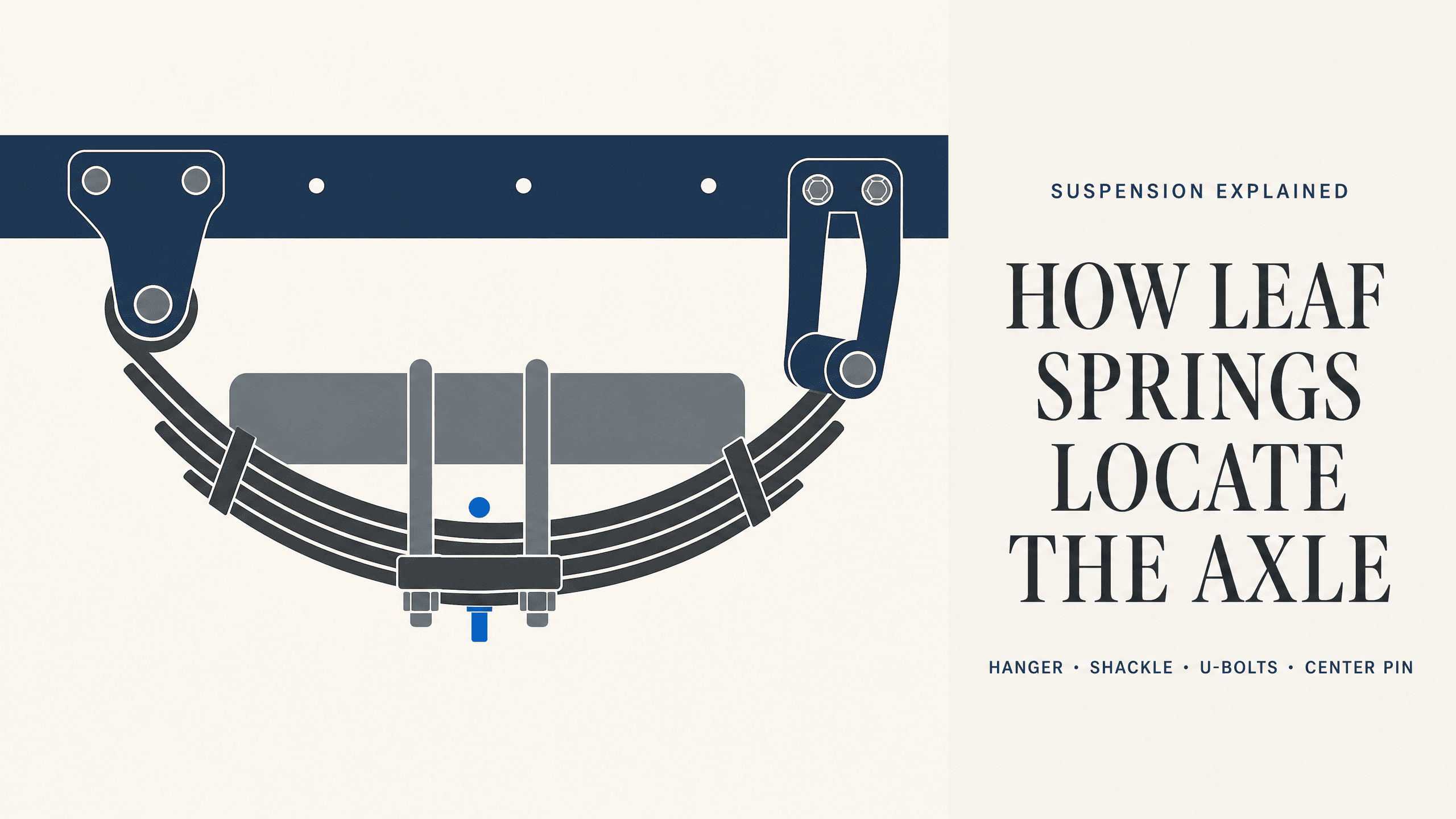
Leaf springs do a lot more than just absorb bumps and carry weight. If you’ve ever wondered how a solid-axle pickup, truck, or trailer can run without a complex multi-link suspension setup and still keep the axle firmly in position — that’s the leaf spring doing its job.
Quick answer
Leaf springs hold the axle in place through a combination of three things:
– The leaf spring hanger and shackle create a geometric constraint that limits fore-aft movement of the axle.
– Leaf spring U-bolts clamp the axle tightly to the spring pack, creating a rigid mechanical connection.
– The width and stiffness of the leaf spring itself provide lateral stability, while the center bolt precisely locates the axle on the spring.
In other words, a leaf spring isn’t just a spring — it’s also a structural locating component.
Understanding the Leaf Spring as a Locating Component
To get how this works, it helps to look at the individual parts that make up a leaf spring suspension system and what each one contributes to keeping the axle where it should be.
1.leaf spring hanger
The spring eye is bolted through bushings to the hanger, which is welded to the frame. This front mounting point essentially sets the reference position for the entire spring—it’s the fixed anchor.
2.leaf spring shackle
The rear end isn’t bolted solid. Instead, it connects through a shackle that can swing. Why? Because when a leaf spring compresses, it flattens out and effectively gets slightly longer. The shackle allows that length change to happen without binding. Without it, the spring would fight itself every time it flexed.
3.leaf spring bushings
Bushings sit inside the spring eyes and provide a cushioned pivot point. When they wear out, axle location degrades—you’ll usually notice clunking noises and vague, wandering handling before anything else.
4.leaf spring u-bolts
U-bolts are what lock the axle to the spring pack. If they loosen up—and they can, especially after hard use or if they weren’t torqued properly—the axle can shift. Loose U-bolts are one of the most common causes of axle misalignment in leaf spring setups.
5.leaf spring center bolt
The center bolt holds the entire spring pack together and seats into a locating hole on the axle perch. This prevents the axle from sliding side to side or shifting fore-aft relative to the spring. If the center bolt shears, the axle can walk off its position—a serious problem.
6.leaf spring clamps
Clamps (also called leaf spring clips) don’t directly secure the axle, but they keep the individual leaves from splaying sideways under load. By holding the pack together as a unit, they indirectly improve the overall stability of the suspension system.
Fore-Aft Location
Think of a leaf spring as a long, flexible link. The front end is fixed at the hanger, the rear end swings on the shackle, and the axle is clamped in the middle. When the axle tries to move forward or backward, the spring body itself resists that force. Add in the geometric constraint of those two mounting points, and the axle has very little room to move longitudinally — no multi-link system required.
Lateral Stability
Leaf springs are built wide and flat, which gives them a natural resistance to lateral forces. As long as the bushings are in good shape and the U-bolt clamping force is correct, the axle has a hard time shifting sideways on the spring perch.
That said, under extreme conditions—hard off-roading, side slopes, or running oversized tires—some vehicles benefit from additional lateral locating devices like a Panhard bar or torque arm for extra control.
What to Check If Something Feels Off
If your trailer is swaying, the rear of your truck feels unstable, or you’re seeing unusual tire wear, here’s what to inspect:
– U-bolts: Are they loose, stretched, or deformed?
– Bushings: Are they cracked, dried out, or showing excessive play?
– Shackles: Are they bent or distorted?
– Bolts: Any signs of shear or cracking that could compromise location?
– Spring pack: Has it sagged significantly or lost leaves to breakage?
As a general rule, metal corrosion tends to be the bigger issue for trailer leaf springs (especially boat trailers), while overloading and fatigue are more common culprits on truck leaf springs.
FAQ
Q: Do leaf springs need additional locating arms or links?
A: No. A leaf spring inherently functions as both a spring and a locating member—it controls axle position without needing extra links.
Q: Can trailer sway be caused by leaf spring issues?
A: Yes. Sagging springs, worn bushings, or loose bolts can all amplify sway. If your trailer is wandering more than usual, the suspension is one of the first things to check.
Q: I just installed new leaf springs and now the handling feels worse—why?
A: The most common causes are incorrect bushing preload, wrong shackle angle, or U-bolts that aren’t torqued to spec. Any of these can throw off the locating geometry. Go through each one systematically.
Leaf springs are a proven package deal—they handle load support and axle location in one relatively simple system. As an established manufacturer in China, Everlasting has extensive experience producing custom leaf springs for trucks, trailers, and off-road applications. If you have any sourcing or purchasing needs, feel free to reach out to us anytime.