 Skip to content

How are leaf springs manufactured?
Leaf springs may seem like nothing more than a simple stack of curved steel plates, but we want our customers to gain a deeper understanding of our product.
I. Material Selection
Material properties determine the upper limit of service life.
The first step in manufacturing a leaf spring is selecting the appropriate material based on its intended application.
The primary material used is specialized leaf spring steel, typically silicon-manganese steel or other alloy steels (e.g., 60Si2Mn, 55CrMnA, 50CrVA). These steels exhibit high tensile strength, excellent elastic recovery capability, superior fatigue resistance, and are difficult to replace.
The steel used for truck and trailer leaf springs must withstand hundreds of thousands of compression cycles and elastic rebounds. Although ordinary carbon steel is inexpensive, it rapidly develops cracks under repeated stress, making it both unsafe and uneconomical.
II. Cutting and Forming
Upon arrival at the factory, steel materials are cut according to design drawings to ensure precise dimensions and lengths of the finished products.
The main shaft is typically the longest section, with both ends rolled into spring eyes for installing leaf spring bushings.
The secondary sheets are stacked according to varying lengths, with different types of leaf springs exhibiting distinct structural configurations. The cutting methods for multi-leaf and mono-leaf springs also differ slightly, and final shaping requires heat treatment calibration.
III. Heat Treatment
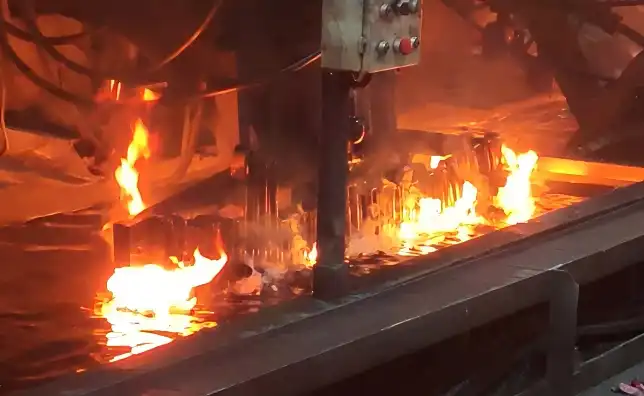
The heat treatment process of a leaf spring directly determines its performance.
The standard process includes quenching and tempering.
Quenching is performed using oil at temperatures ranging from 850°C to 950°C, depending on the material; this step enhances hardness and provides sufficient strength to the steel.
Then temper at 450°C to 550°C, avoiding slow cooling to reduce brittleness and enhance toughness.
If the hardness is too high, the material tends to fracture; if too low, it risks collapse. Thus, a simple “heat-and-cool” process cannot replace industrial heat treatment, especially for heavy-duty leaf springs where heat treatment control must be exceptionally stringent.
IV. Shot Peening
After heat treatment, shot peening is typically performed to create a compressive stress layer on the steel plate surface, thereby preventing crack propagation.
In long-term heavy-load leaf spring suspension systems, this reinforcement is crucial as it significantly enhances fatigue resistance.
Without this step, the lifespan of leaf springs will be significantly shortened.
V. Corrosion Resistance
Steel oxidizes when exposed to air and moisture, and the operating conditions of heavy-duty trucks or trailers often involve suboptimal road surfaces, necessitating surface treatment.
The most common method is E-coating, which involves forming a uniform, dense, and highly adhesive polymer coating on the surface through electrochemical deposition.
Effective surface treatment prevents corrosion from compromising spring strength while enhancing aesthetic appeal.
VI. Assembly
Springs with a multi-layer structure are stacked together.
Use the leaf spring center bolt to secure all blades, and install leaf spring clamps on both sides to prevent lateral displacement.
Leaf spring bushings will be installed at the spring positions to provide adequate cushioning when connected to the frame.
Once this step is completed, the leaf spring assembly is essentially complete.
VII. Quality Inspection
After manufacturing is complete, we do not ship the product immediately.
Standard procedures typically include radius measurement, load testing, and fatigue cycle testing.
The product may only be released from the factory after passing all tests.
Can I do it myself?
Unless your garage happens to have professional materials, heat treatment equipment, E-coating equipment, and strength testing equipment, we do not recommend attempting this yourself.
Self-made leaf springs carry extremely high risks; it’s best to entrust them to professional manufacturers.
From material selection and forming to heat treatment, strengthening, and testing, every step determines the final performance of a leaf spring, requiring a comprehensive and mature industrial chain.
Safety comes first. If you need a professional leaf spring manufacturer, please feel free to contact us anytime.