 Skip to content

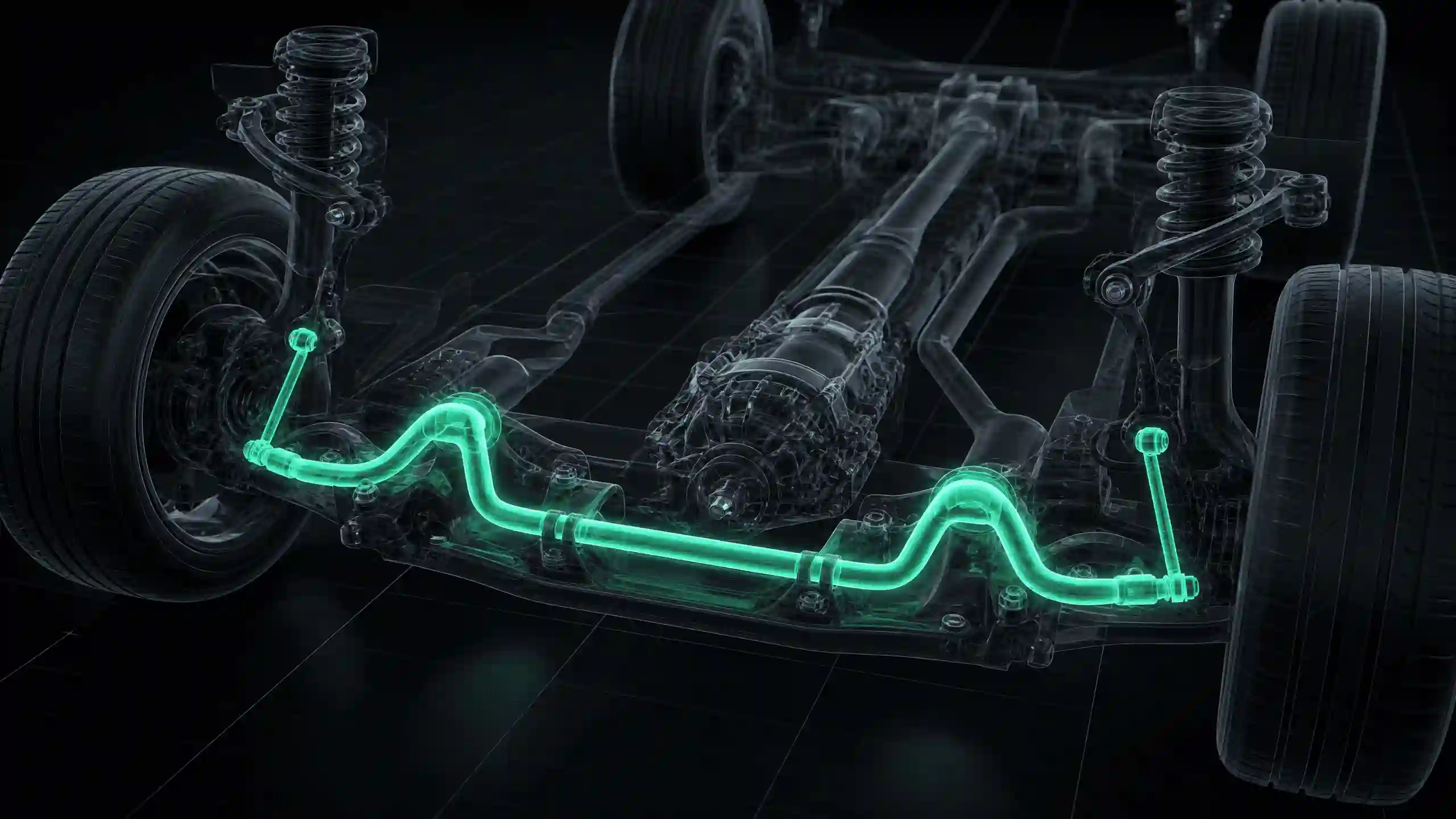
The sway bar is a seemingly minor component of a vehicle’s suspension system, and many people only become aware of its existence during chassis inspections.
So, what does a sway bar do?
Is it really that important? What consequences would arise if it were damaged?
Let’s discuss this in detail.
What is a Sway Bar?
The sway bar, also known as a stabilizer bar, anti-roll bar, or anti-sway bar, may have different names but refers to the same component.
It is a steel rod installed horizontally between the vehicle’s left and right suspension systems, typically categorized as either a front sway bar or a rear sway bar.
The sway bar is connected to the suspension system via sway bar links and secured to the vehicle frame using sway bar bushings.
In simple terms, the sway bar connects the suspensions of the left and right wheels to ensure synchronized performance and dynamic balance.
What do sway bars do
Explaining the principles directly might sound somewhat abstract; let’s start with the driving experience.
A sway bar reduces vehicle side lean: Due to centrifugal force, a car tends to tilt outward during cornering—a phenomenon known as “body roll.” Without a sway bar, this tilt becomes more pronounced, making the vehicle harder to handle and less stable.
In essence, the primary function of a sway bar is to minimize vehicle body tilt during turns.
When one side of the suspension is compressed and the other side is stretched, the sway bar can partially counteract the lateral tilting force.
A sway bar enhances driving dynamics: once vehicle side lean is controlled, the contact area between tires and road surface becomes more stable, resulting in improved traction.
This makes vehicle steering more direct and body attitude more controllable during turns.
A sway bar enhances driving safety: For SUVs, pickup trucks, or vehicles with a high center of gravity, a well-maintained sway bar provides crucial extra stability in critical situations.
During emergency lane changes or high-speed turns, the vehicle is more prone to losing control without adequate anti-roll support.
Geographically speaking, the front sway bar primarily affects steering response and front-wheel grip, while the rear sway bar mainly helps maintain rear-wheel stability and prevent tailspin or excessive steering.
The required sway bars vary depending on the vehicle model; if you’re unsure, feel free to consult our technical staff.

How does a Sway Bar work?
Structurally speaking, a sway bar is essentially a torsion bar.
When both wheels move up and down simultaneously (when passing a speed bump), the anti-roll bar hardly contributes to operation.
However, when one wheel bears the load alone (during cornering or when crossing a pit on a single side), the anti-roll bar twists; the resulting counterforce is transferred to the opposite suspension side, thereby restoring vehicle balance.
This is how the sway bar suspension system achieves stability.
Do I need to replace the Sway Bar?
Typically, the sway bar itself has a long service life and rarely fails; only the sway bar bushings usually require replacement.
Please note that both the sway bar itself and its bushings can be replaced individually; however, to maintain consistent performance, it is recommended to replace them in pairs.
In summary, a properly designed sway bar reduces vehicle side lean during turns, enhances driving stability, and improves safety on uneven road conditions.
As you can see, although the sway bar is merely a seemingly simple metal rod on the chassis, it is indispensable in the vehicle’s suspension system. Regularly checking the condition of the sway bar system is crucial for ensuring safe driving.